Women's History Quiz: The Pioneers and Milestones Guide

Introduction
Every March, Women's History Month sends quiz fans hunting for the stories that textbooks squeezed into margins: the first woman to win a Nobel Prize, the country that granted women the vote first, the programmer who wrote software for the moon landing. A good women's history quiz is a shortcut through two centuries of courage, discovery and hard-won rights.
This guide maps the territory a quiz will actually cover — suffrage and citizenship, science and exploration, arts and activism, and the modern milestones still being set — with the dates, names and records that separate a lucky guess from a confident answer.
This guide is one part of the wider Bing quiz universe — see how every format fits together in our complete Bing Quiz guide.
What Is the Women's History Quiz?
The Women's History Quiz is a knowledge challenge spanning the achievements, movements and firsts of women across politics, science, literature, sport and civil rights. It rewards knowing both the headline pioneers — Curie, Earhart, Parks, Tubman — and the structural milestones: suffrage dates, landmark laws, first elections and barrier-breaking appointments.
Three zones organize the subject. The movements: suffrage, labor, civil rights and the waves of feminism. The individuals: firsts and record-setters across every field. The hidden figures: women whose contributions were overlooked, uncredited or attributed to men, now being restored to the record.
What Is the History of the Women's History Quiz?
Organized women's rights campaigning began in the 19th century: the 1848 Seneca Falls Convention in New York issued the Declaration of Sentiments demanding equality, and suffrage movements formed across the United States, Britain, New Zealand and beyond. New Zealand became the first self-governing nation to grant women the national vote in 1893.
The early 20th century brought the big suffrage victories — Finland in 1906 (also the first to grant women full parliamentary rights, including the right to stand for office), Britain in stages in 1918 and 1928, and the United States with the 19th Amendment in 1920 — alongside pioneers in science and exploration: Marie Curie won Nobel Prizes in two different sciences, and Amelia Earhart flew the Atlantic solo in 1932.
The later 20th century added the civil-rights and workplace chapters: Rosa Parks' 1955 bus stand sparked the Montgomery boycott, the 1960s-70s feminist wave transformed law and custom, and women began breaking the highest barriers — first prime ministers and presidents, first Supreme Court justices, first astronauts — a process that continues with new firsts every year.
| Year | Milestone |
|---|---|
| 1848 | Seneca Falls Convention launches the organized US women's rights movement. |
| 1893 | New Zealand becomes the first nation to grant women the national vote. |
| 1903 | Marie Curie becomes the first woman to win a Nobel Prize. |
| 1920 | The 19th Amendment grants American women the vote. |
| 1955 | Rosa Parks' arrest ignites the Montgomery bus boycott. |
| 1960 | Sirimavo Bandaranaike of Ceylon becomes the world's first female prime minister. |
| Today | Women hold record numbers of leadership roles — and new firsts keep coming. |
How Does the Women's History Quiz Work?
Women's history quizzes range from month-themed trivia nights every March to classroom assessments and general-knowledge rounds. Most mix eras and fields deliberately: a suffrage date, a Nobel first, a civil-rights moment, a sporting record — so broad reading beats deep specialization.
The structure below mirrors that mix: movements, individuals, hidden figures and modern milestones, each covered with the specifics quizzes ask. Study the timeline for dates, the statistics for country-by-country suffrage order, and the comparison table for the classic firsts.
Can You Beat Our Women's History Quiz Practice Quiz?
Ready? Ten questions, instant feedback, full explanations — exactly the style of the real thing. No sign-up, no timer.
How Is the Women's History Quiz Scored?
One point per question with explanations. Date questions reward anchoring the timeline (1893, 1920, 1955, 1963). 'First' questions are the classic trap zone — first female prime minister (Bandaranaike, not Indira Gandhi) and first woman in space (Tereshkova, not Ride) trip up more players than any others.
Interesting Facts
- New Zealand granted women the national vote in 1893 — the first self-governing nation to do so.
- Marie Curie remains the only person to win Nobel Prizes in two different sciences.
- Finland in 1906 was the first nation to grant women full political rights, including standing for office.
- Switzerland granted women the federal vote only in 1971; Appenzell Innerrhoden held out locally until 1990.
- Margaret Hamilton's Apollo code stack was famously printed as tall as she was.
- Katherine Johnson's trajectory calculations were personally verified by John Glenn before his 1962 flight.
- Sirimavo Bandaranaike became the world's first female prime minister in 1960, in Ceylon.
- Junko Tabei was the first woman to summit Mount Everest, in 1975.
- The 19th Amendment passed the House by exactly the two-thirds margin required, after decades of failure.
- Women were first admitted to the US military service academies in 1976.
Statistics & Key Data
| Nation | Year women won the national vote | Notable |
|---|---|---|
| New Zealand | 1893 | First self-governing nation |
| Australia | 1902 | Excluding most Indigenous voters until 1962 |
| Finland | 1906 | First with full rights, including office |
| United Kingdom | 1918/1928 | Partial at first, equal in 1928 |
| United States | 1920 | 19th Amendment |
| Switzerland | 1971 | Among the last in Europe |
Comparison
| First | Correct pioneer | Common wrong answer |
|---|---|---|
| Female prime minister | Bandaranaike (1960) | Indira Gandhi (1966) |
| Woman in space | Tereshkova (1963) | Sally Ride (1983) |
| Female Nobel laureate | Marie Curie (1903) | Bertha von Suttner (1905 Peace) |
| Solo Atlantic flight | Earhart (1932) | Amy Johnson (1930, England-Australia) |
| Everest summit | Junko Tabei (1975) | Reinhold Messner's partners |
What Are the Pros and Cons of the Women's History Quiz?
Advantages
- Covers two centuries in one sitting — the fastest survey of the subject available.
- Balances movements with individuals, so you learn systems and stories together.
- Flags the classic confusion pairs that cost points in every trivia night.
- Restores hidden figures — programmers, mathematicians, pilots — to their place in the record.
- Ideal for Women's History Month events, classrooms and family game nights.
Disadvantages
- Ten questions can only sample a vast subject — whole regions get one mention.
- Date-heavy questions reward memorization over understanding.
- Western milestones dominate; global firsts deserve deeper separate study.
- Some 'firsts' depend on definitions (self-governing nation, full rights) that quizzes gloss over.
How Can You Score Higher on the Women's History Quiz?
- Anchor five dates first: 1848, 1893, 1903, 1920, 1955 — most quiz questions hang on one of them.
- Learn the confusion pairs as pairs: Tereshkova/Ride, Bandaranaike/Gandhi, Curie/Suttner.
- Remember Curie's double: Physics 1903, Chemistry 1911 — the only two-science laureate.
- New Zealand 1893 and Finland 1906 are the most-asked suffrage facts — know why each is 'first'.
- Hidden figures are trending quiz material: Hamilton (Apollo software), Johnson (trajectories), Lovelace (first algorithm).
- For March events, expect modern milestones too: first female vice presidents, Nobel counts, sporting records.
- When unsure between two famous names, pick the earlier date — quizzes love the 'actually earlier' reveal.
What Mistakes Should You Avoid in the Women's History Quiz?
- Answering Indira Gandhi for first female prime minister — Bandaranaike preceded her by six years.
- Crediting Sally Ride as first woman in space — she was the first American, twenty years after Tereshkova.
- Dating US suffrage to 1918 — that's Britain's partial measure; the US year is 1920.
- Assuming Australia 1902 made it second — Indigenous exclusions complicate the claim, and quizzes test that nuance.
- Giving Marie Curie one Nobel — she won two, in different sciences.
- Placing Seneca Falls in Boston or Philadelphia — it was Seneca Falls, New York, 1848.
- Forgetting that 'first' depends on scope: national vote, full rights, and local holdouts differ.
Deep Dive
The Suffrage Century
Winning the vote took, in most countries, fifty to seventy years of organizing: petitions, marches, hunger strikes, and — in Britain — the militant suffragette campaign that made 'votes for women' a front-page crisis. The timeline quiz fans need is selective: New Zealand 1893, Finland 1906, Britain 1918/1928, the United States 1920, France 1944, Switzerland 1971. Each date has a story, and quizzes test the outliers — especially how late Switzerland and parts of the United States (for women of color, effectively 1965) truly were.
The strategic insight for players: suffrage questions are really geography-plus-date questions. Anchor New Zealand first, Finland for 'full rights', and your own country's date, and the majority of suffrage questions become elimination exercises.
Two Nobels, One Name
Marie Curie's record is genuinely singular: Nobel in Physics (1903, with Pierre Curie and Henri Becquerel, for radiation research) and Nobel in Chemistry (1911, solo, for radium and polonium). No one else holds Nobels in two sciences. She named polonium after her native Poland, coined the term 'radioactivity', and ran mobile X-ray units at the WWI front — 'petites Curies'.
Quiz traps cluster around the details: her daughter Irene Joliot-Curie also won a Nobel (Chemistry, 1935); her lab notebooks remain radioactive and are stored in lead-lined boxes; and she was initially omitted from the 1903 nomination until Pierre insisted. Each of these is a real quiz question.
Hidden Figures and Restored Credit
A defining theme of modern women's history is restoration: contributions documented but uncredited in their time. Katherine Johnson calculated trajectories for Mercury and Apollo missions while NASA's human computers were segregated; John Glenn reportedly asked for her by name to verify the electronic computer's numbers before his 1962 orbit. Margaret Hamilton led the MIT team writing Apollo's guidance software and coined 'software engineering' to legitimize the work.
The pattern extends across fields: Rosalind Franklin's X-ray images were central to the DNA structure discovery; Jocelyn Bell Burnell discovered pulsars while her supervisor took the Nobel; Lise Meitner explained nuclear fission while Otto Hahn took the prize alone. Modern quizzes increasingly test exactly these names — learning them is both good history and good quiz strategy.
The Civil-Rights Chapter
Rosa Parks was not a tired seamstress who stumbled into history: she was a trained NAACP activist, and her 1955 arrest was a planned test case in a long campaign. The Montgomery bus boycott that followed ran 381 days, ended with a Supreme Court ruling, and demonstrated that organized economic pressure could defeat segregation law.
The wider chapter includes Ella Baker's organizing philosophy, the Freedom Riders, the 1964 Civil Rights Act (which banned sex discrimination partly through a famously backfiring amendment attempt), and Title IX in 1972, which transformed women's education and sport. Quizzes treat these as one connected era — know the sequence and the dates fall into place.
Firsts in the Highest Offices
The political firsts make a compact, very quiz-able list: Sirimavo Bandaranaike, first female prime minister (Ceylon, 1960); Indira Gandhi (India, 1966); Golda Meir (Israel, 1969); Margaret Thatcher, first in Europe as UK prime minister (1979); Vigdis Finnbogadottir, first democratically elected female president (Iceland, 1980). In the United States, Sandra Day O'Connor joined the Supreme Court in 1981, and Kamala Harris became the first female vice president in 2021.
The quiz discipline is precision: 'prime minister' versus 'president', 'elected' versus 'appointed', and which barrier fell in which country. The Bandaranaike/Gandhi confusion alone appears in a remarkable share of trivia nights.
Science, Exploration and the Record Books
Beyond Curie, the science firsts stack deep: Ada Lovelace's 1843 algorithm notes, Elizabeth Garrett Anderson as Britain's first female physician, Junko Tabei summiting Everest in 1975, and Valentina Tereshkova's 1963 solo spaceflight — still the only solo mission by a woman. Exploration firsts include Earhart's 1932 Atlantic crossing and, a generation later, women reaching both poles and every continent's highest summit.
For quizzes, exploration questions test the pairing of feat and year, and occasionally the 'only' records: Tereshkova's solo status and Curie's two-science record are the two most reliable 'actually unique' facts in the category.
The Modern Milestones Era
Women's history is still being written at quiz speed: record numbers of women in legislatures worldwide, the first female heads of the IMF, European Central Bank and major central banks, first female astronauts commanding stations, and Nobel rosters slowly diversifying. Women's History Month quizzes now routinely mix 1893 with last year's firsts.
The preparation strategy follows: master the historical canon, then scan the past twelve months of 'first woman to...' headlines before any March event. The mix of old anchors and new milestones is what separates current champions from players stuck in last decade's study guide.
Women in Sport: The Title IX Effect
One 1972 US law rewrote women's sport: Title IX banned sex discrimination in federally funded education, and within decades female participation in school and college sports multiplied many times over. The pipeline produced the dominance of US women's teams — four World Cups and multiple Olympic golds in soccer alone.
The global milestones stack alongside: Billie Jean King's 1973 'Battle of the Sexes' win over Bobby Riggs, equal prize money at the tennis majors (Wimbledon last, in 2007), and women's events filling the Olympic program. Title IX 1972, King 1973, Wimbledon 2007 — the sports-history trinity quizzes love.
The Nobel Women
The Nobel roll of women begins with Marie Curie (1903) and grows through icons: Bertha von Suttner (Peace, 1905), Selma Lagerlöf (Literature, 1909), Rosalind Franklin's famous exclusion, Mother Teresa (Peace, 1979), Malala Yousafzai (Peace, 2014 — the youngest laureate ever at 17).
Quiz patterns: Curie's two-science double, Malala's age record, and the category gaps — women remain a small minority of laureates, a disparity that is itself a common exam point. Franklin's non-award for DNA work (she died before the 1962 prize; Nobels are not given posthumously) is the classic 'was she robbed' question — answer: the rulebook, not a vote.
When is Women's History Month?
March in the United States, the UK and Australia; Canada observes it in October. International Women's Day falls on March 8.
Who was the first woman to win a Nobel Prize?
Marie Curie, in Physics in 1903 (shared with Pierre Curie and Henri Becquerel). She won a second, in Chemistry, in 1911.
Which country gave women the vote first?
New Zealand, in 1893 — the first self-governing nation to grant women the national vote. Finland in 1906 was first to include the right to stand for office.
Who are the 'hidden figures' of women's history?
Contributors long overlooked or uncredited: NASA mathematician Katherine Johnson, Apollo software lead Margaret Hamilton, programmer Ada Lovelace, and many scientists whose work was published under male colleagues' names.
What was the Seneca Falls Convention?
The 1848 gathering in Seneca Falls, New York, organized by Elizabeth Cady Stanton and Lucretia Mott, which issued the Declaration of Sentiments and launched the organized US women's rights movement.
Who was the first woman in space?
Soviet cosmonaut Valentina Tereshkova, who flew Vostok 6 in June 1963 — nearly twenty years before Sally Ride became the first American woman in space.
How should I prepare for a women's history trivia night?
Anchor the five core dates (1848, 1893, 1903, 1920, 1955), learn the confusion pairs, review the hidden figures, and skim modern milestones — then take practice quizzes like the one above.
Related Reading
- Father's Day Quiz: Origins, Dates and Traditions Worldwide — more history & culture: father's day quiz
- Fairy Tales Quiz: The Complete Storybook Guide — more history & culture: fairy tales quiz
- Bing Mardi Gras Quiz: The Complete Carnival Guide — more history & culture: bing mardi gras quiz
- Billionaires Quiz: The Complete Wealth Guide — more history & culture: billionaires quiz
- Bing Inventions Quiz: The Complete Guide to World-Changing Ideas — more history & culture: bing inventions quiz
- Wellbeing Quiz: The Science of a Good Life — more history & culture: wellbeing quiz
- Extraordinary Women Quiz: The Pioneers You Need to Know — more history & culture: extraordinary women quiz
- Join My Quiz: The Complete Guide to Playing Together — more history & culture: join my quiz
People Also Read
- Bigfoot and Friends Quiz: The Complete Cryptid Guide — Nature & Wildlife: Explore our Bigfoot and Friends quiz guide: Sasquatch, Yeti, Nessie an…
- Bing Art Quiz: The Complete Guide to Art Trivia — Entertainment: Master the Bing Art quiz: famous paintings, artists, movements and mus…
- Stephen King Quiz: The Complete Horror Master Guide — Movies & TV: Enter our Stephen King quiz guide: It, The Shining, Carrie and the mas…
- Santorini Quiz: The Complete Island Guide — Geography & Travel: Discover our Santorini quiz guide: the volcano, white villages, Minoan…
- Bing Golf Quiz: The Complete Player's Guide — Sports: Master the Bing Golf quiz: the four majors, Tiger and Jack's records, …
- Bing Winter Quiz: The Complete Cold-Season Guide — Nature & Wildlife: Chill with our Bing Winter quiz guide: solstice science, snowflakes, w…
- Croissant Quiz: The Complete Guide to the Crescent — Food & Drink: Sink your teeth into our Croissant quiz guide: the pastry's Austrian o…
- Bioluminescence Quiz: The Complete Guide to Living Light — Science & Discovery: Glow with our Bioluminescence quiz guide: fireflies, glowing seas, ang…
Explore Next
- Next in History & Culture: Father's Day Quiz: Origins, Dates and Traditions Worldwide
- All History & Culture guides
- Editor's Picks — what players love right now
- Staff Picks — the reader favorites
- Latest Quizzes — fresh from the desk
- Quiz Glossary — the terms every player should know
In the Knowledge Graph
This guide connects to profiled entities — each with timelines, relationships and a knowledge panel:
👤 Marie Curie 👤 Valentina Tereshkova 👤 Sonora Smart Dodd 👤 Amelia Earhart 👤 Rosa Parks 👤 Junko Tabei 👤 Naomi Osaka 👤 Anna Jarvis 📍 New Zealand 📍 Montgomery 🎉 Mother's Day
Related Quizzes & Topics
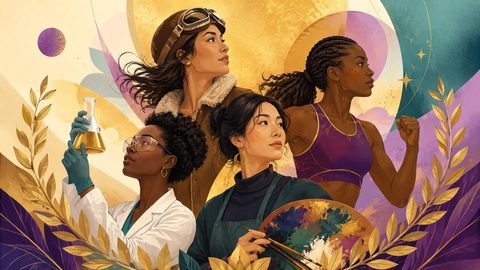
Extraordinary Women Quiz: The Pioneers You Need to Know
Meet the pioneers behind the Extraordinary Women quiz: scientists, aviators and artists, the facts to remember…
Wellbeing Quiz: The Science of a Good Life
Master the Wellbeing quiz with evidence-based facts on sleep, movement, mood and longevity — what science actu…
Bing Quiz: The Complete Guide to Every Format
Explore every Bing quiz format in one guide: homepage, news, weekly and themed quizzes — how each works, exper…
Summary
In short: A women's history quiz covers the people, firsts and turning points that standard timelines long left out: the suffrage movements that won the vote country by country, pioneers like Marie Curie, Amelia Earhart and Rosa Parks, the scientists whose work was credited to others, and the laws that changed daily life. This guide walks the essential eras and figures, then tests you with a free 10-question quiz. The essentials to remember are the key records and facts in the tables above — master those, play the practice quiz until it feels easy, and the next live edition of the women's history quiz will feel like revision.
References & Further Reading
- UN Women — Women's rights timeline
- National Women's History Museum
- Nobel Prize — Marie Curie biography
- NASA — Katherine Johnson biography